Rehabilitation equipment
 Rehabilitation
Robotics is revolutionising rehabilitation by offering innovative solutions. Thanks to advanced technology, robotics allows precise, repetitive and personalised movements. These tools complement the care provided by health professionals and make some manipulations easier. Below is a non-exhaustive list of the rehabilitation equipment we have tried.
Lokomat exoskeleton

The Lokomat is a kind of exoskeleton working on a treadmill. This robotic system provides repetitive movement to integrate a good walking pattern. The patient does the exercises with body-weight support; the aim is for the assistance to be gradually reduced.
The Lokomat thus contributes to a gradual reorganisation of the brain through articulated robotic walking orthoses, a dynamic body-weight support system and software that records the patient’s contribution during fun exercises shown on a screen.
The expected benefits are: confidence, motivation, flexibility, muscle power, endurance, resistance to fatigue, etc.
The problem? For a long time, there was only one for paediatric use in France (in Nice, with a long waiting list…). We travelled to Poland and Madrid many times to find one. After 2 weeks of use, 45 minutes a day, we noticed each time that Enora A. had a better leg swing and walked more smoothly and faster with her walker.
Today, as far as we know, there are 3 paediatric Lokomats in France: in Nice, in Paris and in the Landes. We’re getting there!
The G-EO robot
We discovered the G-EO thanks to Guillemette Moreau-Pernet, a determined physiotherapist based in Clermont-Ferrand. Her association Ekipe Medical Recherche acquired this robotic gait-training machine. The principle differs slightly from the Lokomat, because the legs are driven from under the feet. This has pros and cons: the advantage is that it can simulate going up and down stairs. The drawback is that, to keep the legs aligned, the physiotherapist has to step in to keep the knees straight.
In October 2020, we were lucky enough to have a few sessions with Guillemette to try the G-EO robot. The video opposite shows Enora experiencing the sensation of going downstairs. You can see the huge amount of joint work it requires. The repetition of the movement, weight-bearing and the choice of range of motion are very beneficial for integrating the motor pattern. This machine is also suitable for adults as well as very young children (as long as they are at least 85 cm tall).
Innowalk VR
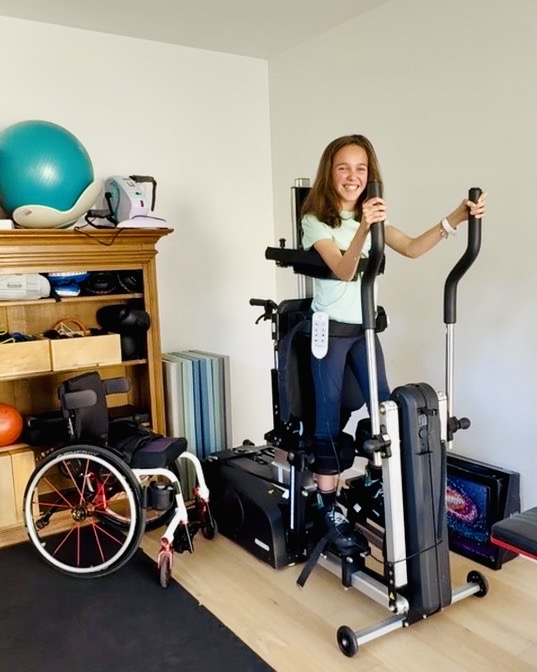
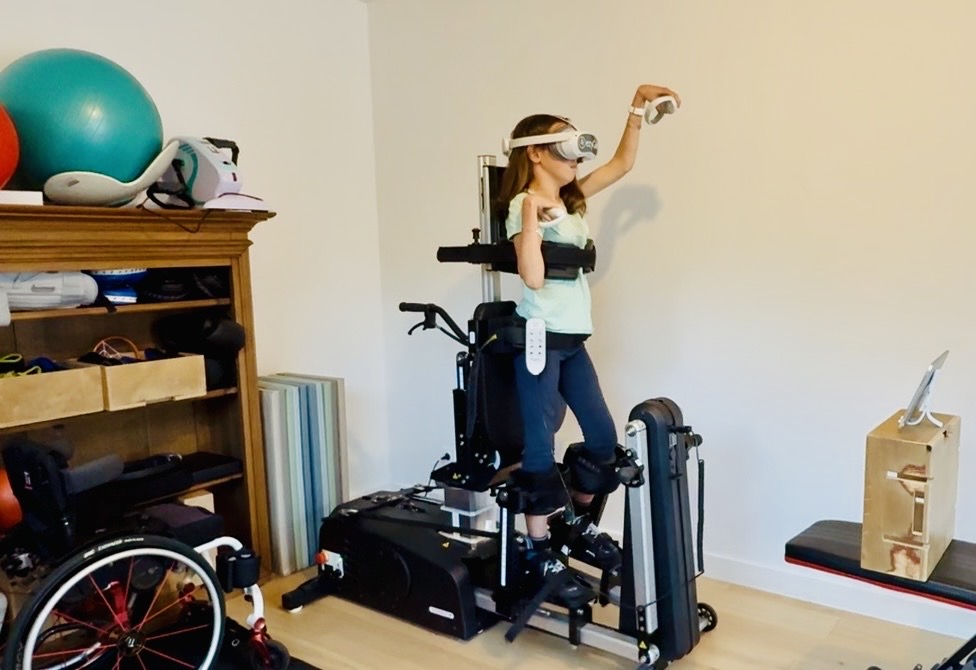
Inspired by the elliptical trainers found in gyms, the Innowalk lets people with disabilities experience walking safely with a motorised, repetitive movement. It supports the person upright, bearing their body weight, whatever their motor level, so it provides weight-bearing (important to prevent osteoporosis), activates the muscles and stretches the tendons. The arms also move, alternating with the legs.
What makes the Innowalk special: the company originally designed it for home use, so it is very easy to use compared with similar devices. The user experience has been designed to make it easier to use. For example, getting in and out is done with a swivel seat and folding leg supports. It comes in several sizes for children, teenagers and adults.
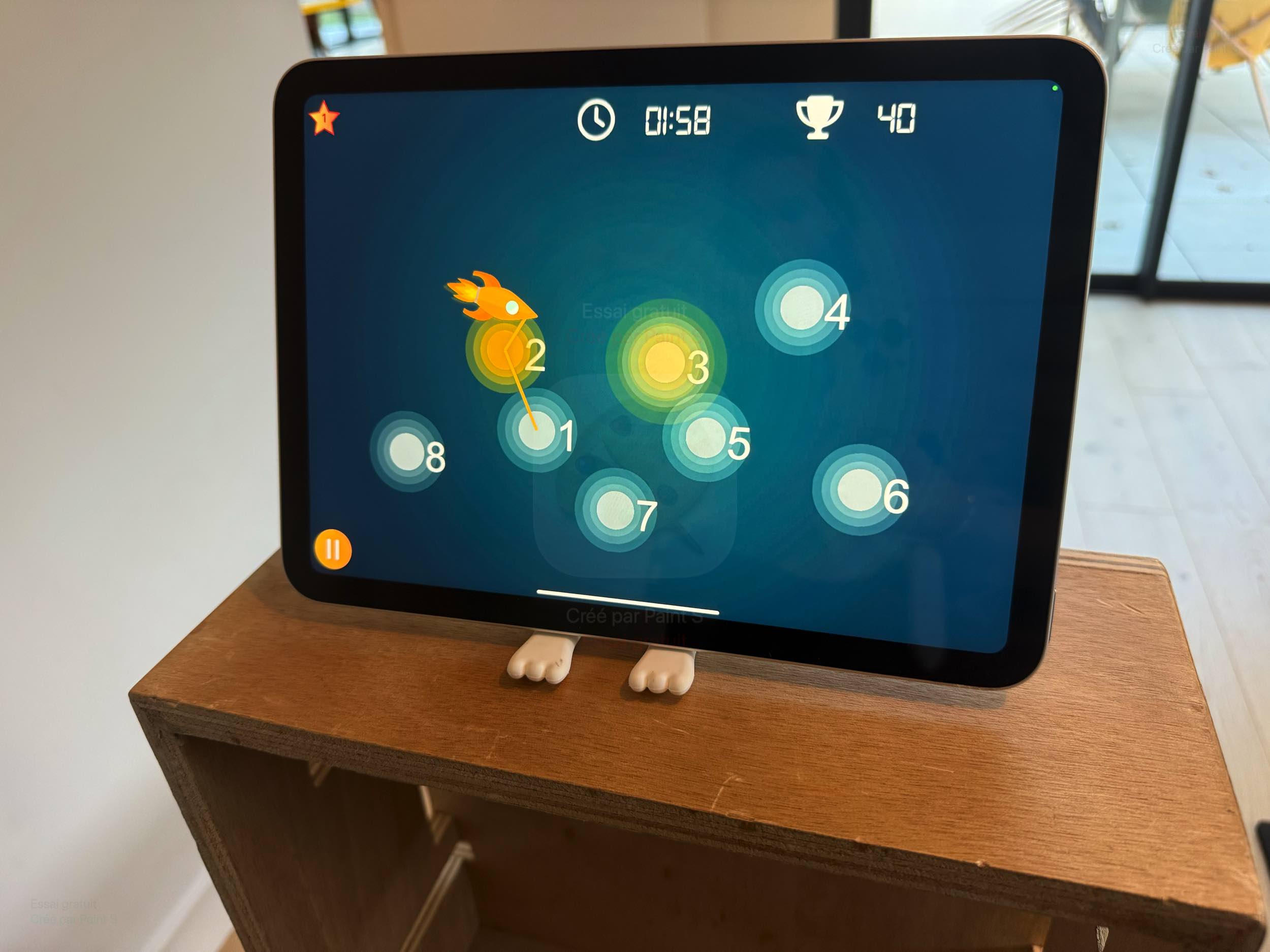
We had had our eye on this device for a while, but Ezygain gave it a new lease of life by combining it with virtual reality (VR)! With a tablet and interactive games, the cognitive stimulation is more intense and more motivating for the child or teenager! For more information or even a trial, don’t hesitate to contact them on our behalf at contact@ezygain.com
For 4 months, Enora A. has been lucky enough to use it 3 or 4 times a week, for 30 to 50 minutes per session. It is very easy to use. We are seeing better activation of the psoas (hip flexors), a stronger push through the legs (anti-gravity reflex) and active stretching of the legs and ankles. This matters to us all the more during the growth spurt of adolescence. What’s more, our pre-teen is very motivated by the virtual reality! It is not just a gadget; it is an experience that lets her teleport to another environment with a real feeling of going for a walk “like an able-bodied person”.
Galileo vibration platform

Vibration platforms work by generating reflex muscle contractions, based on proprioception mechanisms.
The benefits are seen in strength, balance and bone density, mainly in people with reduced mobility or at risk (post-menopausal women, sedentary people). Studies in athletes are inconclusive, although vibration seems to have an interesting effect on proprioception, which is useful for rehabilitation or preventing sprains. Finally, the “relaxing” effect of vibration is used to treat muscle stiffness linked to spasticity.
Exercises can be done standing, sitting, kneeling or even leaning on the arms.
Which device to choose?

There is an important difference between the platforms on the market. Some vibrate (Power-Plate® type) and some oscillate (Galileo® type). The former move vertically, up and down, while the latter move alternately, right–left. The latter reproduces a movement pattern similar to human walking. This difference is fundamental and, in addition, produces 2 to 3 times less acceleration at head level than vibrating platforms.

Each machine has different movement, amplitude and frequency settings. Beware of models that do not offer stimulation above 10 Hz or 15 Hz: they are unlikely to be effective. The number of reflex stretch contractions per second is determined by the adjustable training frequency. For example, if a training frequency of 25 Hz is selected, there are 25 cycles of flexor and extensor muscle contraction per second. A 3-minute training session at 25 Hz therefore produces 4,500 muscle contractions!
Motomed

The Motomed is an electric indoor bike that can be used actively or passively, whatever the user’s motor level. It is quite versatile, since it can be used from a wheelchair or an ordinary chair, and even lying down! It works the legs and/or the arms.
The Motomed costs between €5,000 and €6,000 and is generally available in rehabilitation centres.
Electric mini exercise bike
We found an alternative to the Motomed for less than €200. It is admittedly less sophisticated, but enough for our children’s needs: an electric mini exercise bike (pedal exerciser). You can find them at Decathlon or Fnac.
Here is a video of Enora training for about fifteen minutes (she then switches to her arms). Even though she pedals passively (electric mode), we still see better activation of the hip flexors after use.
Fine motor skills and the iPad
And to think we were against screens before the age of 3… Never say never!
Around the age of two and a half, we discovered the potential of the iPad (or other tablets). There is a whole arsenal of educational apps that help children work on fine motor skills, and also on the prerequisites for starting nursery school (shapes, colours, sizes, emotions, visual discrimination, etc.).
Our favourite apps are these:- tracing lines: https://itunes.apple.com/fr/app/jecris-en-cursive-apprendre/id757843896?mt=8
- all the Tinyhands apps
- the Sago Mini apps
More and more speech therapists use tablets, and many websites list dedicated apps; here are a few (in French):
- Commission scolaire de Montréal: apps for children with special needs
- A comprehensive list in this article on speech therapy
- Another article on “le blog de Za”, a young occupational therapist who is also well informed about alternative communication methods.
Armeo
Being written